As 2025 comes to a close, it’s the perfect time to reflect and celebrate everything we’ve achieved together at cheqd. This year has been one of growth where we’ve expanded our partnerships, strengthened our product offerings, and continued to build the foundations for a more trustworthy digital ecosystem.
From breaking new ground in verifiable AI and agent trust solutions, to driving real adoption of verifiable credentials, this year has been full of big steps for us in digital identity, privacy, and decentralised trust. We’ve teamed up with amazing organisations across different industries, shown up at major global events, launched new tools and protocols, and supported our community in building things that genuinely make a difference.
In this end-of-year recap, we’re pulling together the highlights: our key milestones, partnerships, product updates, awards, and some of the stories that show what cheqd’s mission looks like in action. We bring self-sovereign identity and verifiable trust into the real world.
Product & Protocol Updates
One of the biggest things we pulled off this year was launching our MCP-enabled Agentic Trust solution, built on the Model Context Protocol. In simple terms, it gives AI agents a secure, accountable way to operate by giving them cryptographically verifiable identities and permissions. Developers can now build apps where AI agents actually manage their own DIDs and Verifiable Credentials, all backed by cheqd’s trust graph and the TRAIN validation engine to make sure everything lines up with proper governance rules. Our Verifiable AI demos with Claude and the MCP server really brought this to life. They showed that secure, accountable AI agents aren’t some far-off idea. They’re doable right now.
On the protocol side, we pushed out several upgrades focused on making everything more scalable, more usable, and more interoperable. The v3.1.9 release introduced fee abstraction, which basically means people can make transactions using IBC-enabled tokens like USDC. Later, v4.1.1 brought improvements across identity management, token transfers, and IBC functionality. And then v4.1.4 tightened things up even further with better state sync, cleaner error-log pruning, and a dedicated relayer channel to support USDC through Osmosis. All together, these updates made transactions way more flexible, boosted cross-chain capabilities, and generally improved network performance.
Outside the protocol layer, our ecosystem and tooling moved forward in a big way too. cheqd Studio was upgraded to make credential issuance simpler, including direct integration with Dock and its wallet, allowing developers to issue and manage credentials more easily. The update also improved how trust registries and trust graphs are managed, giving organisations clearer control over who can issue and verify credentials. And with deeper integrations into AI agent systems, developers can now use verifiable credentials in much more creative ways, letting autonomous agents authenticate, transact, and interact securely while keeping trust and accountability baked into every step.
Partnerships & Alliances
cheqd’s partnerships and alliances to build interoperable trust networks
- Dock Labs: They migrated their entire credentialing setup and production traffic to cheqd; they have then had a new influx of partners, e.g. Telefonica
- Hovi: They used our infrastructure to make issuing and verifying credentials easier for regulated pilots in education and security; two pilots are already underway, one in the UK with Salibo (Security sector) and another in Brazil with G7MED (EdTech).
- Anonyome Labs: We joined forces to push forward better consumer privacy, cyber safety, and verifiable digital identity tools; one client is running on the network albeit unpublicised, more will be shared later.
- OriginVault: Built a platform for generating content credentials using cheqd DIDs and DID-Linked Resources.
- VERA: We partnered to bring secure digital identity and trusted messaging to businesses across Africa, helping grow verifiable ID adoption globally.
- JuliaOS: They integrated cheqd so their ecosystem can issue credentials, support verifiable trust, and provide auditor attestations natively.
- PlatformD: Built a privacy-preserving compliance layer for DeFi using cheqd, enabling real-time validator credential checks without any central authority.
- Sovereign AI Alliance (SAIA): Alongside Datahive, Nuklai, and Datagram, we formed this alliance to build frameworks for decentralised, user-owned AI.
- Artificial Superintelligence Alliance (ASI): Collaborated with Fetch.ai, SingularityNET, Ocean Protocol, and CUDOS to implement the Agentic Trust Solution across decentralised AI ecosystems.
Accelerator Programs
This year was a big one for us on the accelerator front. cheqd got into three really prestigious programmes, and each one helped us grow in different ways.
First up was the JPMorgan Chase Fintech Forward Program, where we got access to mentorship, industry connections, and support that helped us sharpen how we position our trust infrastructure for the financial sector. It was a great chance to validate our market approach and refine the product in a really focused way.
We also joined the Barclays Eagle Labs Scaleup Program, which gave us guidance on our commercial strategy, plus tons of networking and validation opportunities. The workshops, peer sessions, and introductions to corporate partners were genuinely valuable for helping us scale.
And on top of that, we were selected for Tech4Trust Season 7 in Switzerland. It is an accelerator focused on digital trust and cybersecurity. It renders coaching across sales, legal, and operations, along with direct access to corporate decision-makers. We also have the chance to compete for prizes worth up to 150k CHF, another nice competitive edge to the whole experience.
Verifiable AI Hackathon
The Verifiable AI Hackathon 2025, which we hosted together with Dorahacks, Verida, and Sprite+, brought a whole community of builders together to explore how cheqd’s infrastructure can power secure, verifiable, and trustworthy systems. Participants tackled everything from identity verification to how AI agents interact with each other.
The projects this year were seriously impressive.
In the Agentic Economy & AI Agents track:
- Identone took first place with a really clever approach to verifiable, voice-based agent interactions.
- Kith came in second for building AI agent passports.
- SNAILS grabbed third with a solution focused on identity and content verification inside Telegram.
In the Content Credentials & Other track:
- CheqDeep won first place with a tool for proving whether media is authentic.
- Trusty Bytes placed second by helping AI agents access trusted datasets.
- crdbl came third with a system for making digital content auditable and verifiable.
And on top of that, Viskify won the Verida Bounty for its AI-powered talent verification platform. A great example of how verifiable credentials are starting to make a real impact in professional settings.
All in all, the hackathon really showed what’s possible when verifiable data meets creative builders.
Community & Governance
Our community continued to play a central role in shaping cheqd’s network and ecosystem throughout 2025. A total of 11 proposals have been launched with 10 of them successfully passing as shown below.
- Proposal 59: Put 1,000,000 $CHEQ into boosting liquidity on both Osmosis and Uniswap.
- Proposal 60: Updated the mainnet to v3.1.5 to make things run smoother and add a few improvements.
- Proposal 61: Added the USDC IBC denom so people can send USDC across the network.
- Proposal 62: Fixed an expired IBC connection with Secret Network to keep cross-chain transfers working.
- Proposal 63: Did the same for Gravity Bridge; renewed the expired IBC client to keep everything interoperable.
- Proposal 64: Upgraded to v3.1.9, which included general improvements and fee abstraction for IBC tokens.
- Proposal 65: Moved up to v4.1.1, adding better identity features, improved token transactions, and smoother IBC transfers.
- Proposal 66: Updated to v4.1.4 to sort out state sync issues, clean up logs, and open a new relayer channel for USDC via Osmosis.
- Proposal 68: Reduced network inflation to roughly 1.5% to stay on track for the long-term 1 billion $CHEQ supply target.
- Proposal 69: Approved 1,000,000 $CHEQ for OriginVault’s Public Utility Tool to onboard up to 10,000 Verified Person Credentials and support the launch of a C2PA registry under OpenVerifiable.
Market Recognition & Awards
This year, we were genuinely honoured to get some recognition from the wider tech community for what we’re building in digital trust. In HackerNoon’s Startups of the Year 2024 (announced in 2025), cheqd came in 10th and Creds took 18th in the London region. A really nice nod from the community and a sign that our work on self-sovereign identity and verifiable credentials is resonating.
We were also named one of the Top 100 Web3 & Blockchain Companies by the World Future Awards 2025, which highlighted the work we’re doing around secure, decentralised, privacy-preserving infrastructure. On top of that, Startups.co.uk ranked cheqd 34th in their Startups100, pointing to another great milestone for us.
And to cap things off, at South Summit Korea 2025, cheqd was awarded “Most Scalable Business”, a recognition that really speaks to the momentum we’re building with verifiable credentials and Agentic AI across different industries.
All of this meant a lot to us, and it’s a credit to the team, our partners, and the community around cheqd.
Events & Conferences
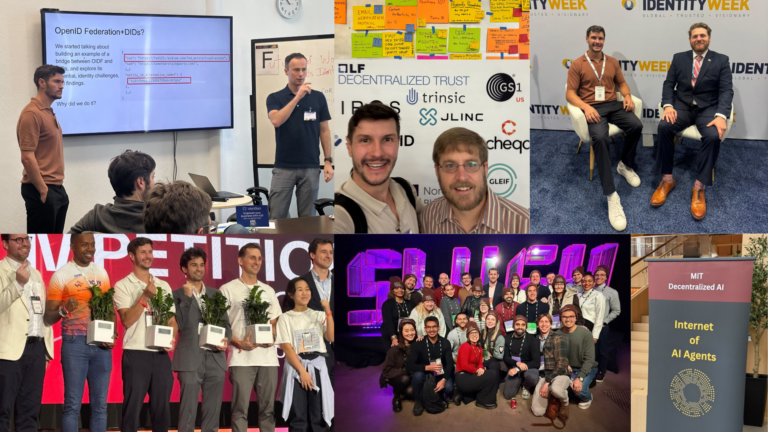
In the first half of the year, we stayed pretty active on the events front. cheqd sponsored the didx Unconference Africa, DICE, and the Internet Identity Workshop (IIW) Spring, helping move conversations forward around verifiable credentials, digital trust, and AI-driven ecosystems. At the European Identity & Cloud Conference, Fraser delivered a keynote on how identity ecosystems actually grow and create value, and Ankur joined panels on Verifiable AI and Personhood Credentials, connecting with a lot of the key players in the space. Later on, at Identity Week Europe, we had the chance to speak directly with policymakers and enterprise teams, and our Verifiable AI work was also highlighted at MIT’s Decentralised AI event (Project NANDA).
In the second half of the year, the momentum continued. We showed up at Identity Week America and Korea Blockchain Week, digging into regional trends around digital identity and decentralised trust. We also sponsored IIW Fall, which gave us another great opportunity to showcase real-world implementations of DIDs, SSI, and Verifiable AI. Fraser co-presented a session there on how OpenID Federation can blend with decentralised identifiers, which sparked some really productive conversations. And at the Global Digital Collaboration Conference, our team explored new trust frameworks and open standards for scaling verifiable credentials across borders.
The year wrapped up on a high note at South Summit Korea 2025, where cheqd was selected as a finalist and awarded “Most Scalable Business.”
Media, Thought Leadership & Education
All through 2025, we kept sharing our thoughts on digital trust, self-sovereign identity, and AI, and it was great to see that work picked up by the wider community. Fraser was featured in places like Cointelegraph, Binance, Messari, and Blockster, which helped bring more attention to the ideas we’ve been pushing forward.
We also put out a bunch of blogs covering everything from AI Agents and Digital Product Passports to Credential Payments and the different layers of the SSI industry. The aim was to break things down in a way that made both the technical and economic sides of verifiable credentials easier to understand.
On top of that, our team joined a lot of podcasts and AMAs, including Cryptopolitan, Unfungible, INATBA, Aeonix, and Agentic AI X Spaces. We also saw coverage in outlets like TNGlobal, Thales Cloud Security IAM360, Deloitte, and Hackernoon, which was a really nice boost for the broader digital identity work we’re doing.
And at the Sprite+ showcase, we took things a step further by showing real, practical examples of how our AI Agent Frameworks and Relationship Guides work in practice, including both the Human-Centred and Entangled versions that help developers and designers build better agent interactions.
All in all, it’s been a strong year for getting our ideas and our tech out into the world.
Next Horizons in 2026

Moving Into 2026 we aim to double down our efforts on verifiable AI, developing narrower products across segments of the AI Agent market. This focus will encompass the technology stacks from cheqd Studio, applying them coherently to different problems that AI companies are facing. For example, we aim to utilise our trust graph model to create an algorithmically defined and pluggable reputation score for companies and agents, across multiple marketplaces. We will also continue exploring how to apply DID-Linked Resources to Agent Passports, cryptographically linking associated metadata that requires persistent and highly available storage.
We will launch our Oracle release at the start of 2026, releasing a guide for validators to securely transition to the next major version in January 2026, upgrading to testnet and then mainnet. This release will stabilise pricing for all identity transactions on the network against fixed dollar values, giving cheqd’s customers and partners far more confidence in using the network, without price volatility. We expect this release to pave the way for new clients to launch live on cheqd mainnet with strong guarantees around pricing.
Concurrently, we will continue supporting our core SSI partners as their clients continue moving into production environments, optimising the ledger to continually improve transaction speeds and state handling. If 2025 was the year of first adoption, 2026 will be the year of scale.